Recall Feedback Guide
What it is
Recall Feedback is your human judgment about whether the recalled references actually helped the turn.
It is not mainly about whether the prose is good. It is about whether the recalled material:
- was the right material
- pulled the scene off focus
- failed to bring in what truly mattered
Over time, it helps answer:
- does the system more often miss key context, or bring in too much irrelevant context?
- are the recurring issues about conflict, relationships, foreshadowing, timeline, or lore?
When to use it
It is most useful when:
- you have just read a reply and your judgment is clear
- one specific recalled item was especially helpful or especially harmful
- you want a few rounds of stable human signals before adjusting recall behavior
If your complaint is mostly about rhythm, wording, or style, you do not always need Recall Feedback. It is better for evaluating whether the reference material itself was right, enough, and on-topic.
The three most common signals
1. Helpful
Use it when:
- the recalled material genuinely helped the turn continue correctly
- relationship state, main conflict, or timeline was carried forward well
- an older clue or fact supported the current scene at the right time
In short: the system brought in the right thing, and it helped.
2. Distracting
Use it when:
- the recalled material was true, but not right for the current focus
- an already resolved thread kept returning
- old background material stole attention from the present scene
- the reply started expanding in the wrong direction
In short: it got brought in, but it pulled attention away.
3. Missing
Use it when:
- the most important carryover never arrived
- a key fact, relationship shift, or timeline anchor was absent
- the reply feels thin, disconnected, or blind to the real point
In short: what should have been there was missing.
Two kinds of feedback you can record
1. Whole-turn feedback
This is your judgment of the overall recall quality for the turn.
It helps answer:
- was this turn broadly helpful or off-topic?
- did this turn have enough support?
- what was the main problem for this round?
If you only want a fast signal, this is usually enough.
2. Single-reference feedback
This is your judgment about one specific recalled item.
It helps answer:
- this scene reference was crucial and helped
- this long-term memory item was outdated and kept stealing focus
- this open thread reference distorted the scene after being included
If you already know which item caused the issue, this is the more precise option.
How to record feedback well
The most useful feedback usually includes these pieces:
1. Pick the signal first
Start with the main direction:
- helpful
- distracting
- missing
Getting this right matters more than writing a long explanation.
2. Add the reason
Common reason labels include:
- main conflict
- relationship shift
- unresolved thread
- timeline anchor
- continuity guard
- wrong focus
- stale context
- resolved thread
- missing core fact
You do not need many. One or two is usually enough.
3. Add the affected writing dimension
For example:
- conflict
- relationship
- suspense
- setting
- timeline
- motivation
- continuity
- foreshadowing
This helps later when you want to see patterns across multiple rounds.
4. If the signal is missing, be specific about what was missing
The highest-value note is usually short and concrete.
For example:
- missing the carryover that they were still cold after the bell tower argument
- missing the fact that the key had already been swapped
- missing the timeline anchor that this was the third morning
Specific notes are much easier to use later.
5. Keep the note short and plain
You do not need to write a report.
One clear sentence is enough, such as:
- this older lore fact is true, but it should not be competing with the main conflict here
- the scene missed the emotional aftershock of the relationship shift, so the reaction felt too flat
How to read the report and summaries
After a few rounds, check the session Recall Report, or the recent human feedback summary inside Prompt Debug.
The most useful views are usually these:
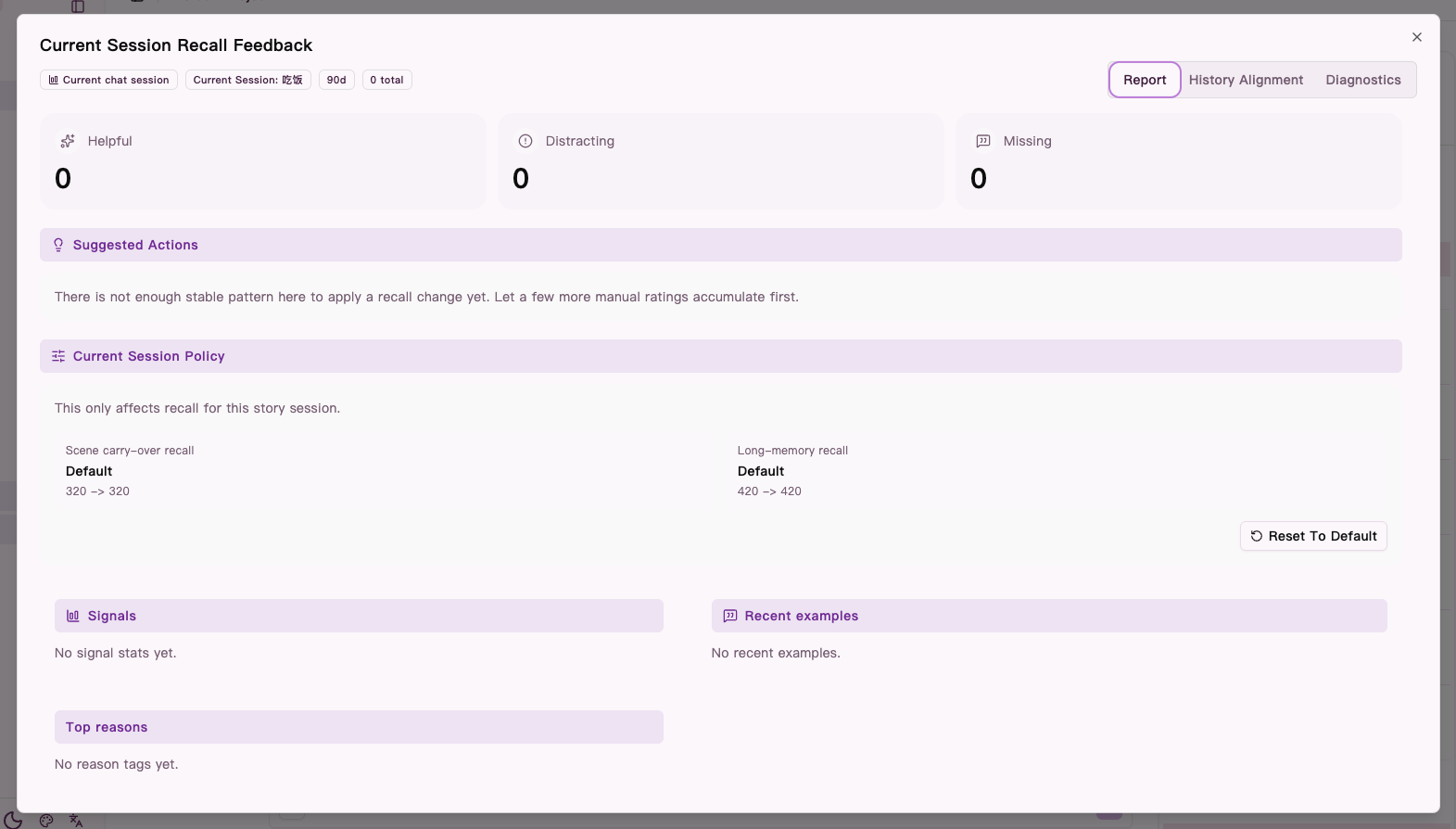 Figure: the
 Recall Report summarizes helpful, distracting, and missing signals, along with recent trends and suggested actions for the session.
1. Current chat vs whole project
- current chat: useful for local problems on one story line
- whole project: useful for repeated patterns across many chats
If the current chat is strongly missing-heavy but the whole project is not, the problem is probably local to this line. If the whole project trends distracting for a long time, recall may be too wide in general.
2. Signal distribution
First ask which signal is showing up most often:
- more helpful: direction is mostly right
- more distracting: recall often pulls focus away
- more missing: recall often fails to bring in what matters most
3. Top reason labels
If you keep seeing things like:
- main conflict
- relationship shift
- timeline anchor
- continuity guard
that usually means the issue is repeating in the same creative area, not appearing by accident.
4. Recent examples and creator notes
This is often the best human-readable review layer because it shows:
- which recent turns were most representative
- what creators were actually unhappy with
- whether the main problem was "wrong things got in" or "the right things never arrived"
Turning feedback into action
You do not need to change settings after every note. It is usually better to wait for a pattern.
If missing keeps repeating
The next thing to check is usually:
- whether current-scene carryover is too weak
- whether old clues or background facts are failing to follow through
- whether the missing material is near-scene context or long-range context
If distracting keeps repeating
The next thing to check is usually:
- whether too much old material keeps being brought in
- whether already resolved threads are still entering recall
- whether background information is stealing focus from the present scene
If helpful becomes more common
That usually means:
- recall direction is getting more stable
- your feedback is becoming more consistent
- later adjustments will be easier to judge
What to keep in mind
1. You are judging recall effect, not literary quality
A reply can be plain while recall was still correct. That does not always deserve negative feedback.
Recall Feedback is mainly about:
- did it bring in the right thing?
- did it bring in enough?
- did it pull focus away?
2. Short and specific beats long and vague
The most useful entries are usually:
- one clear signal
- one or two reason labels
- one concrete note
3. Several rounds beat one emotional reaction
A single turn can be noisy. A few turns in a row are much better for seeing stable patterns.
One-line takeaway
The value of Recall Feedback is not writing a lot every time. It is consistently telling the system which recalled material truly helped, which stole the scene, and which essential context keeps going missing.